Showing posts with label making the invisible visible. Show all posts

Tuesday, 16 November 2010

Ross Ching: Running on Empty

What if, tomorrow, everyone’s car disappeared?

Originally a concept by Matt Logue, Empty LA

Ross Ching took Matt Logue’s still photography concept and applied it to something that he did best — time lapse photography. He built a story around the idea of people in LA being shackled to a ball and chain; a love-hate relationship with whom they spend so much time with there in LA.

The video he has created consists of long time exposure photos and photoshop effects so anything that moves "disappears", combined with a time lapse effect "it gives you that beautiful eerie feel of a city devoid of any human life after some kind of wipe out, Destruction or something else." - Immo Blaese


Ross Ching: Running on Empty 2010

Ross Ching: Running on Empty Video:
http://vimeo.com/11986171

Ross Ching: Running on Empty
http://rossching.com/running-on-empty

Matt Logue: Empty LA
http://mlogue.com/p586914549

Eadweard Muybridge:

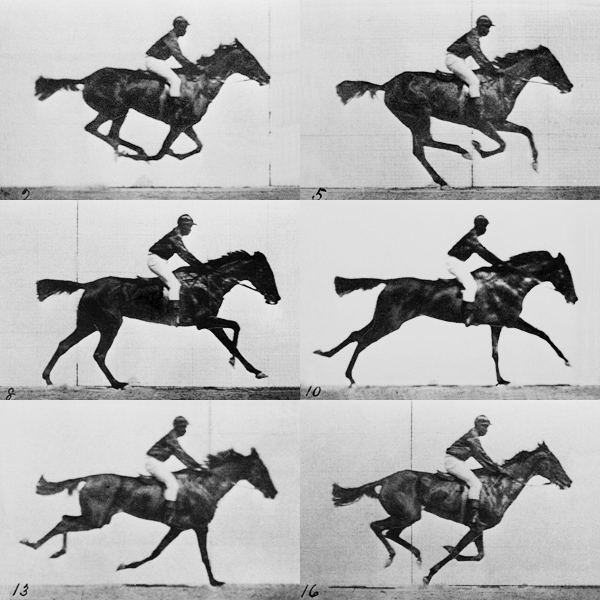
Muybridge was the man who famously proved a horse can fly. Adapting the very latest technology to his ends, he proved his theory by getting a galloping horse to trigger the shutters of a bank of cameras. This experiment proved indisputably for the first time what no eye had previously seen – that a horse lifts all four hooves off the ground at one point in the action of running. Seeking a means of sharing his ground-breaking work, he invented the zoopraxiscope, a method of projecting animated versions of his photographs as short moving sequences, which anticipated subsequent developments in the history of cinema.


Sequence of a horse jumping by Eadweard Muybridge (d.1904)

Eadweard Muybrideg:
http://en.wikipedia.org/wiki/Eadweard_Muybridge

Eadweard Muybrideg: Animated race horse
http://upload.wikimedia.org/wikipedia/commons/d/dd/Muybridge_race_horse_animated.gif

Tate Britain: Eadweard Muybridge Exhibition
http://www.tate.org.uk/britain/exhibitions/eadweardmuybridge/default.shtm


Bullet Time:

Bullet time is a special and visual effect that refers to a digitally-enhanced simulation of variable-speed (i.e. slow motion, time-lapse, etc) photography used in films, broadcast advertisements, and video games.

It is characterized both by its extreme transformation of time (slow enough to show normally imperceptible and unfilmable events, such as flying bullets) and space (by way of the ability of the camera angle—the audience's point-of-view—to move around the scene at a normal speed while events are slowed).

This is almost impossible with conventional slow-motion, as the physical camera would have to move impossibly fast; the concept implies that only a "virtual camera", often illustrated within the confines of a computer-generated environment such as a virtual world or virtual reality, would be capable of "filming" bullet-time types of moments.


The Matrix: 2009

Bullet Time:
http://en.wikipedia.org/wiki/Bullet_time

The Matrix:
http://en.wikipedia.org/wiki/The_Matrix

Michel gondry: Smirnoff
http://www.youtube.com/watch?v=3SdlAXq45VY

Making Future Magic: iPad light painting

This film is a literal, aesthetic interpretation of those ideas, Making Future Magic a collabaration between Dentsu London and Berg.

Exploring media, Screens and light and so they developed a technique using an ipad to light paint single photos that they then layered up to form stop frame animations.

Light painting meets stop-motion:
They developed a specific photographic technique for this film. Through long exposures they recorded an iPad moving through space to make three-dimensional forms in light.

First they create software models of three-dimensional typography, objects and animations. they rendered cross sections of these models, like a virtual CAT scan, making a series of outlines of slices of each form. They played these back on the surface of the iPad as movies, and drag the iPad through the air to extrude shapes captured in long exposure photographs. Each 3D form is itself a single frame of a 3D animation, so each long exposure still is only a single image in a composite stop frame animation.

Each frame is a long exposure photograph of 3-6 seconds. 5,500 photographs were taken. Only half of these were used for the animations seen in the final edit of the film.

This experiment continues on our them of making the invisible visible.


Dentsu London & Berg: Making Future Magic 2010

Making Future Magic video:
http://vimeo.com/14958082

Dentsu London:
http://www.dentsulondon.com/blog/2010/09/14/light-painting/

Berg:
http://berglondon.com/blog/2010/09/14/magic-ipad-light-painting/

David Bowen - Tele-present wind

The wind is a universal natural phenomena, and it's usually associated with weather conditions and forecasts. But it is still perceived as almost unforeseeable and invisible except for its physical impact on plants and for its sibilant sound. Wind has two characteristics in common with the virtual environment: the complexity of conditions needed to be generated (so, often being unforeseeable) and its proliferation in an incorporeal dimension, so being invisible in reality.

tele-present wind is the latest installation by interactive artist david bowen.
the piece consists of 21 x/y tilting devices that are connected to dried plant stalks inside the gallery and a dried plant stalk connected to an accelerometer installed outdoors.
as the stalk outside begins to sway in the wind, the forces on it are measured by the accelerometer, which transmits the data in real time to the stalks inside.
this forces the tilting device to mimic the swaying of the plant outside so that all the stalks are in-sync.


David Bowen: Tele-Present 2008

kinetic, robotic and interactive sculptural works

David Bowen: Tele-present Wind Video
http://www.youtube.com/watch?v=pdhLXAE1sYI

David Bowen: Website
http://www.dwbowen.com/telewind.html